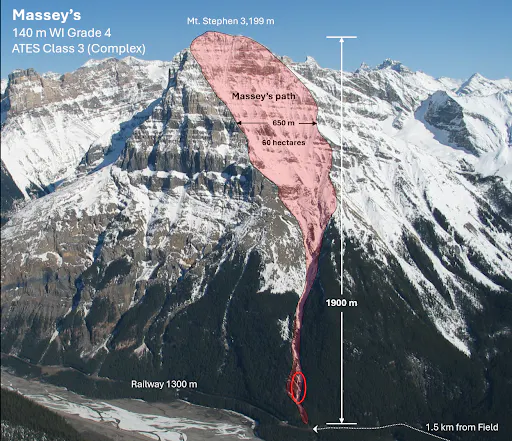
WI 4
140 m
ATES 3 (Complex)
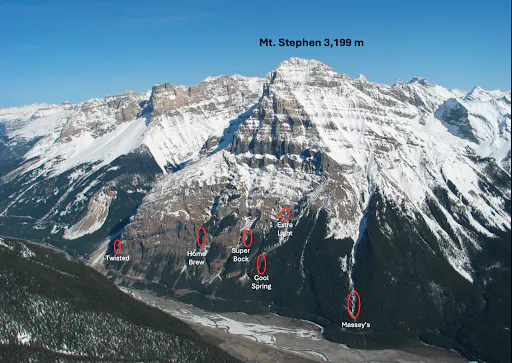
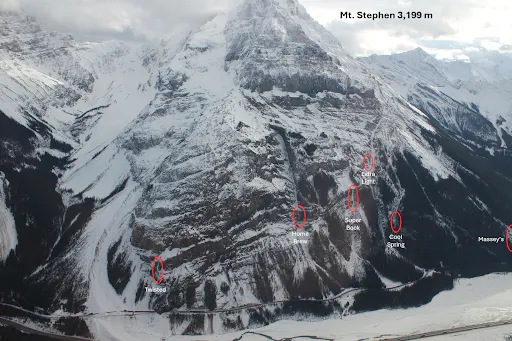
Massey’s is a popular multipitch climb near Field, located at the base of a very large avalanche path. The first pitch is the crux, followed by easier climbing above. Mixed climbing options exist beside the main line. The route has a history of avalanche involvement, including a fatality in 2019.
Popularity
- 12 people completed the survey
- 50% climbed it 1 time
- 17% climbed it 2-5 times
- 33% climbed it over 6 times
Have you ever witnessed an avalanche?
- 50% yes
- 50% no (many the same avalanche)
Avalanche Frequency
- 33% have never seen debris
- 42% less than half the time
- 8% more than half the time
- 17% always observed debris
Avalanche Debris Distribution
- 38% observed debris on the approach
- 87% observed debris at the base
- 25% observed debris between pitches
- 38% observed debris above the final pitch
Key observations
- Debris depths up to 12 m have been reported during spring cycles
- Debris has travelled well beyond the base of the climb
Avalanche Triggers
- 100% natural
Start Zones
- 83% well above the climb
- 17% directly above
Contributing Factors in Order of Significance
- 100% wind
- 33% new snow
- 33% warming
- 17% cornice or rockfall
Reported Avalanches and Incidents
- In March 2019, a large avalanche started high on Mt. Stephen and ran over the climb and beyond. A group of six (4 clients, 2 guides) was caught after descending the route. One person was fully buried and later died; another was buried 1.8 m deep and survived. Rescue was initially carried out without proper equipment, which had been swept away.
- More information on this avalanche can be found in Accidents in North American Climbing and from Avalanche Canada
Other Notes and Summary
- Historical data suggests avalanches reach the runout roughly once per year, though not all reach the climb
- Most avalanches start between 2200–2700 m in broad alpine start zones
- Strong winds at upper elevations are common, even when conditions are calm at the base
- Long cold, clear periods can create weak facet layers that contribute to larger avalanches later
- Access requires care to avoid railway operations
Images